
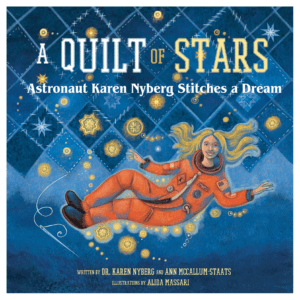
School Library Journal Reviews A Quilt of Stars
Gr 1-4–Karen Nyberg enjoys sewing and dreams of visiting the stars, but she grows up during a time when women are not permitted to become astronauts. Her aspirations change when she watches a televised NASA announcement introducing a new initiative to allow women into the space program. That moment ignites Nyberg’s determination. Over time, she studies diligently, trains rigorously, and continues to sew, an activity that remains central to her identity. These parallel pursuits ultimately converge when Nyberg travels to space and creates a quilt inspired by the stars, symbolizing the blending of her childhood passions and professional achievements. This autobiography is lively and engaging, offering an inspiring narrative of perseverance and possibility. The vocabulary is largely accessible, though the inclusion of occasional complex sentence structures may present challenges for emerging readers. A distinctive feature of the text is its emphasis on Nyberg’s inner life, allowing readers insight into her thoughts, motivations, and evolving self-concept as she moves from dreamer to astronaut. While this narrative approach adds emotional depth and originality, it may need an assist for young readers who are still developing skills in tracking internal reflection. VERDICT An inspiring and thoughtfully written text best suited for upper elementary readers with teacher support.–Tracey Hodges
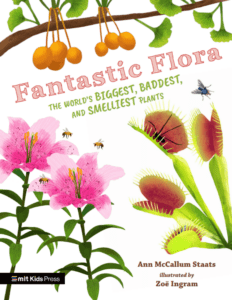
Kirkus Reviews Fantastic Flora
An attractive package that will intrigue and enlighten readers.
Say hello to some peculiar plants. From the Venus flytrap to the flying-duck orchid, McCallum Staats uses descriptions of very large, very poisonous, very smelly, and very strange flora as jumping-off points to introduce basic botanical concepts. A profile of the Bolivian water lily, for instance, segues into an explanation of simple vs. compound leaves. An entry on the giant sequoia is accompanied by discussions of dendrochronology (tree aging) and coniferous vs. deciduous trees, while the profile on the sandbox tree leads to an explanation of the differences among thorns, spines, and prickles. These smoothly written, chatty entries cover a great deal of material, such as scientific names and details about related plants. Though the plants come from all over the world, McCallum Staats often mentions more familiar relatives. (The sandbox tree, for example, is related to the poinsettia.) Ingram includes both lush, striking illustrations of the plants as well as diagrams and close-ups of individual elements, such as the reproductive parts of a flower. Most similar books emphasize various botanical concepts; this clever reversal spotlights the extraordinary examples the writer has chosen, conveying plenty of general information while also wowing young readers. An attractive package that will intrigue and enlighten readers. (glossary, source notes, bibliography, index) (Nonfiction. 9-14) https://www.kirkusreviews.com/book-reviews/ann-mccallum-staats/fantastic-flora/